Fun Facts About the Movie Funny Girl
| Funny Girl | |
|---|---|
 Post-Oscar release poster | |
| Directed by | William Wyler |
| Screenplay by | Isobel Lennart |
| Based on | Funny Daughter
|
| Produced by | Ray Stark |
| Starring |
|
| Cinematography | Harry Stradling, Sr. |
| Edited by |
|
| Music by |
|
| Production | Rastar |
| Distributed past | Columbia Pictures |
| Release date |
|
| Running fourth dimension |
|
| Country | United States |
| Language | English |
| Budget | $14.1 million |
| Box office | $58.5 million[three] |
Funny Girl is a 1968 American biographical musical comedy-drama film directed by William Wyler. The screenplay by Isobel Lennart was adjusted from her volume for the stage musical of the aforementioned title. It is loosely based on the life and career of Broadway and movie star and comedian Fanny Brice and her stormy relationship with entrepreneur and gambler Nicky Arnstein.
Produced by Brice's son-in-law, Ray Stark, with music and lyrics by Jule Styne and Bob Merrill, the picture show stars Barbra Streisand (in her motion picture debut reprising her Broadway part) as Brice and Omar Sharif as Arnstein, with a supporting cast featuring Kay Medford, Anne Francis, Walter Pidgeon, Lee Allen, and Mae Questel. It was the beginning motion picture by Stark'southward company Rastar.
A major disquisitional and commercial success, Funny Daughter became the highest-grossing motion picture of 1968 in the United states and received eight Academy Laurels nominations. Streisand won the award for Best Extra for her performance, tying with Katharine Hepburn (The Lion in Wintertime). In 2006, the American Flick Institute ranked the film #xvi on its list commemorating AFI'southward Greatest Movie Musicals. Previously information technology had ranked the film #41 in its 2002 list of AFI's 100 Years...100 Passions, the songs "People" and "Don't Rain on My Parade" at #13 and #46, respectively, in its 2004 list of AFI'southward 100 Years...100 Songs, and the line "Hello, gorgeous" at #81 in its 2005 list of AFI's 100 Years...100 Motion-picture show Quotes. Funny Girl is considered one of the greatest musical films e'er fabricated.[iv] [5] [6]
In 2016, Funny Daughter was deemed "culturally, historically, or aesthetically meaning" by the United States Library of Congress, and selected for preservation in the National Film Registry.[7] [8]
Plot [edit]
Set in and around New York City just prior to and following World War I, the story opens with Ziegfeld Follies star Fanny Brice awaiting the return of hubby Nicky Arnstein from prison house, and and so moves into an extended flashback focusing on their meeting and marriage.
Fanny is a stage-struck teen who gets her starting time task in vaudeville. Her mother and her friend Mrs. Strakosh endeavor to dissuade her from show business organisation considering Fanny is not the typical beauty ("If a Girl Isn't Pretty"). While rehearsing at a vaudeville theater, boss complains about Fanny's unsynchronized performance and her marker appearance. Upon his conclusion to sack her, she perseveres ("I'thousand the Greatest Star"). With Eddie's help and encouragement, Fanny gets a function in a roller-skating act despite lacking roller-skating skills. Although the act turns into a big mess, the audience discover it to exist hilarious and cheer her up ("Rollerskate Rag"). That is also when Fanny has her get-go performance "I'd Rather Be Blueish Over You (Than Happy With Somebody Else)". Following the debut, she meets the suave Arnstein. Half dozen months after, Fanny gets hired to become a member of the Ziegfeld Follies – something she has always dreamt of. In the debut operation, she put a comic twist to the supposedly romantic number, ending the number as a meaning bride ("His Beloved Makes Me Beautiful"). She meets Arnstein again, who accompanies her to the celebration at her home on Henry Street ("People").
One year later, Fanny is now the rising star of Broadway. She and Arnstein meet over again when she goes to Baltimore as a part of her bout. After having a romantic dinner at a swanky restaurant and declaring their feelings ("You Are Woman, I Am Man"), the pair become romantically involved. Instead of going to Chicago with the Follies, Fanny decides to take another train to New York in order to be with Arnstein ("Don't Rain On My Parade"). While traveling aboard the RMS Berengaria, Nicky promises that if he could win a fortune past playing poker then they could go married, which somewhen comes true. They motion into a mansion and have a daughter ("Sadie, Sadie"), meanwhile Fanny also returns to Ziegfeld and the Follies.
Nick'southward various business ventures fail, causing him to lose a lot of money. Nick being busy gambling and not showing up to Fanny's new play premiere ("Swan") makes her upset and the 2 have an statement. Refusing financial support from his married woman, he becomes involved in a bonds scam and is imprisoned for embezzlement for eighteen months. At the moment of the farewell, Nick calling her "funny girl" leaves her feeling bitter and piteous ("Funny Daughter"). Following Nick'due south release from prison, they concur to separate. She is heartbroken and claims that "I am his forever more than" ("My Human being").
Cast [edit]
- Barbra Streisand every bit Fanny Brice
- Omar Sharif every bit Nicky Arnstein
- Kay Medford equally Rose Brice
- Anne Francis as Georgia James
- Walter Pidgeon equally Florenz Ziegfeld
- Lee Allen as Eddie Ryan
- Mae Questel as Mrs. Strakosh
- Gerald Mohr as Branca
- Frank Faylen as Keeney
- Mittie Lawrence as Emma
- Gertrude Flynn as Mrs. O'Malley
- Penny Santon equally Mrs. Meeker
- John Harmon as Company Manager
- Ruth Clifford as Maid (uncredited)
Musical numbers [edit]
- "Overture"
- "If a Daughter Isn't Pretty" – Fanny, Rose, and Mrs. Strakosh
- "I'm the Greatest Star" – Fanny
- "Rollerskate Rag" – Fanny and Rollerskate Girls
- "I'd Rather Be Bluish Over You (Than Happy With Somebody Else)" – Fanny
- "2d Hand Rose" – Fanny
- "His Love Makes Me Beautiful" – Fanny and Follies Ensemble
- "People" – Fanny
- "Yous Are Woman, I Am Man" – Nicky and Fanny
- "Don't Rain on My Parade" – Fanny
- "Entr'acte"
- "Sadie, Sadie" – Fanny and Nicky
- "The Swan" – Fanny
- "Funny Girl" – Fanny
- "My Homo" – Fanny
- "Get out Music"
Funny Girl originally had 18 musical numbers in 160 minutes of film, lx minutes of which are tuned. Nick Arnstein used to take a solo called "Temporary Arrangement".[ix] Some numbers from the original musical were removed; "Rollerskate Rag", "The Swan" and "Funny Girl" are equanimous specifically for Streisand instead and are not related to Fanny Brice.[10]
Although originally released on her 1964 album People, the song "People" was re-recorded for the film with a unlike tempo and additional lyrics.
In the 1985 book Barbra Streisand: The Woman, the Myth, the Music by Shaun Considine, composer Styne revealed he was unhappy with the orchestrations for the moving-picture show. "They were going for pop arrangements," he recalled. "They dropped eight songs from the Broadway prove and we were asked to write some new ones. They didn't want to go with success. It was the onetime-fashioned MGM Hollywood way of doing a musical. They always alter things to their manner of vision, and they ever do information technology wrong. But, of all my musicals they screwed up, Funny Girl came out the best."[11]
Considering the songs "My Homo", "2nd Hand Rose", and "I'd Rather Be Blue" oft were performed past the existent Brice during her career, they were interpolated into the Styne-Merrill score.
Soundtrack [edit]
The soundtrack album to the film was released by Columbia Records in 1968.
Production [edit]
Development [edit]

The movie is based on the life and love story of Fanny Brice.
Isobel Lennart originally wrote Funny Girl as a screenplay for a drama film entitled My Human being for producer Ray Stark (whose mother in law was Fanny Brice). No studio was interested in the project, except for Vincent Donhue, who suggested turning information technology into a phase musical.[12] Lennart consequently adapted her script for what eventually became a successful Broadway production starring Barbra Streisand.[thirteen]
Although she had not made any films, Streisand was Stark'southward first and only choice to portray Brice onscreen. "I just felt she was too much a part of Fanny, and Fanny was too much a office of Barbra to have it become to someone else," he said, merely Columbia Pictures executives wanted Shirley MacLaine in the role instead.[14] MacLaine and Streisand were expert friends and shared a birthday; both actresses rolled their eyes at the thought. Stark insisted if Streisand were not cast, he would not permit a film to be made, and the studio agreed to his demand.[xi]
Mike Nichols, George Roy Hill, and Gene Kelly were considered to straight the film before Sidney Lumet was signed. After working on pre-product for six months, he left the project due to "creative differences" and was replaced by William Wyler, whose long and illustrious award-winning career never had included a musical film; he originally was assigned to direct The Sound of Music. Wyler initially declined Stark's offer because he was concerned his significant hearing loss would impact his ability to work on a musical. Afterward giving it some thought, he told Stark, "If Beethoven could write his Eroica Symphony, then William Wyler can do a musical."[11]
Streisand had never heard of Wyler, and when she was told he had won the Academy Accolade for All-time Director for Ben-Hur, she commented, "Chariots! How is he with people, like women? Is he any good with actresses?" In fact Wyler had directed Roman Vacation (1953) which won three Academy Awards including the All-time Actress award for Audrey Hepburn who had been chosen by Wyler despite her relative obscurity at that time. As for Wyler, he said, "I wouldn't have done the picture without her." Her enthusiasm reminded him of Bette Davis, and he felt she "represented a challenge for me because she'south never been in films, and she's not the usual glamour daughter".[11]
Casting [edit]
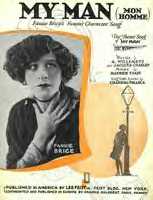
In the moving-picture show'southward finale, Streisand sings "My Man", a melody closely associated with Fanny Brice
Styne wanted Frank Sinatra for the function of Nicky Arnstein, but the actor was willing to appear in the motion picture simply if the role was expanded and new songs were added for the character. Stark thought Sinatra was too old and preferred someone with more class like Cary Grant, even though Grant was eleven years older than Sinatra.[xiii] Marlon Brando, Gregory Peck, Sean Connery, David Janssen, and James Garner were likewise considered. Egyptian Omar Sharif was bandage to star opposite the Jewish Streisand after Wyler noticed him having lunch in the studio commissary. When the Vi-Twenty-four hour period State of war betwixt Israel and Egypt broke out, studio executives considered replacing Sharif, but both Wyler and Streisand threatened to quit if they did. Later, the publication of a notwithstanding depicting a love scene between Fanny and Nicky in the Egyptian press prompted a movement to revoke Sharif's citizenship. When asked about the controversy, Streisand replied, "You lot call up Cairo got upset? You should see the alphabetic character I got from my Aunt Rose!"[11] Anne Francis was cast in a new role equally the lead chorine in the Ziegfeld Follies.[15]
Choreographer Herbert Ross, who staged the musical numbers, had worked with Streisand in I Can Become It for You Wholesale, her Broadway debut.[11]
Filming [edit]
| It doesn't thing how much expensive gear y'all've got, you need to have not a little luck, a great deal of skill, and a telepathic relationship between pilot and cameraman to pull that off. And Nelson Tyler pulled all that off correct back in the mid-sixties. |
| — Jerry Grayson talked near the helicopter shot for "Don't Rain on My Parade"[nine] |
Rehearsals and pre-recording of the songs began in July 1967.[9] During pre-recording, Streisand had demanded all-encompassing retakes until she was satisfied with them, and on the gear up she continued to display her perfectionist nature, frequently arguing with Wyler almost costumes and photography.
Main photography began in August 1967 and was completed past December. Streisand's start scene took place at an abased rails depot in New Bailiwick of jersey where she but got off from the railroad train and posing for the photographers. Filming was more difficult for Barbra than she thought because she had to do a musical numbers multiple times for different camera angles. For the helicopter shot of "Don't Rain on My Parade", aerial lensman Nelson Tyler had to develop a special helicopter camera rig.[9] Streisand allegedly had so many of her scenes with Anne Francis cutting before the moving picture's release that Francis sued to have her name removed from the credits, simply lost.[11] Streisand subsequently claimed she never told Wyler to cutting anything and the terminal flick reflected his choices, non hers. Francis later on said "I have no feud with Barbra. But doing that film was like Gaslight. What infuriated me was the way they did things—never telling me, never talking to me, just cutting. I think they were agape that if they were prissy to me, Barbra would have been upset."[16] Shooting for the musical number "My Man", which the original Fanny Brice made famous, took place at the end of the shooting phase. Sharif was nowadays to aid Streisand get emotional and build upwardly sadness. The crew did at least ten takes. Also in that shoot, Stark thought the moving-picture show would toll $8 million, which he deemed to be "half as much as any other big musical [...] and it will be twice every bit big."[9]
Release [edit]
Prior to releasing, Columbia Pictures produced 3 featurettes for publicity purposes ― "This Is Streisand", "Barbra in Movieland", and "The Look of Funny Girl".[17]
Box office [edit]
Funny Daughter premiered on September 18th, 1968 at the Criterion Theatre in New York; whose ticket cost $100. Information technology was Barbra Streisand's first premiere equally a movie star, and she said she felt like a "kid with a plaything". A month later, on October 9th, the Hollywood Premiere was at the Egyptian Theatre.[17] Having fabricated $24.nine meg, Funny Girl was the highest-grossing film of 1968 in the U.s.a..[18]
Disquisitional reception [edit]
The flick holds a 93% approval rating on review assemblage site Rotten Tomatoes, based on 44 reviews, with an boilerplate rating of vii.half dozen/10. The website'southward critical consensus states: "[Barbra] Streisand elevates this otherwise rote melodramatic musical with her ultra-memorable star plough as Fanny Brice."[nineteen] On Metacritic, the pic has an 89 out of 100 rating, based on seven critics, indicating "universal acclamation".[20] Streisand was widely praised past critics, with The New Yorker 'due south Pauline Kael calling it "A bravura performance .... As Fanny Brice, she has the wittiest comic inflections since the comediennes of the 30s; she makes written dialogue audio similar inspired improvisation. ... Streisand's triumphant talent rides right over the film's weaknesses."[21] In his review in Chicago Sun-Times, Roger Ebert called Streisand "magnificent" and added, "She has the best timing since Mae West, and is more fun to watch than anyone since the young Katharine Hepburn. She doesn't actually sing a song at all; she acts it. She does things with her hands and face that are only individual; that's the but way to describe them. They haven't been done before. She sings, and you're really happy you lot're there." But he idea "the film itself is perchance the ultimate example of the roadshow musical gone overboard. Information technology is over-produced, over-photographed and over-long. The 2d half drags badly. The supporting characters are more often than not wooden . . . That makes the film itself kind of schizo. It is incommunicable to praise Miss Streisand too highly; hard to find much to praise most the rest of the moving picture."[22] Richard L. Coe of The Washington Postal service agreed that the film was "overdone," writing that Streisand was "her starting time-rate cocky" during the musical numbers and "probably is capable of more variety than this," just "is so carefully presented and limited that she and the picture become a long, drippy diameter."[23] Renata Adler of The New York Times wrote that "Streisand's talent is very poignant and potent," but that the film had "something a little condescending nearly it," with Wyler "treating Barbra rather fondly, improbably and even patronizingly," and concluded that "Miss Streisand doesn't need any of this."[24]
Variety said Streisand makes "a marked bear on" and continued, "The saga of the tragi-comedienne Fanny Brice of the ungainly mien and manner, charmed by the suave menu-sharp Nicky Arnstein, is maybe of familiar pattern, simply it is to the credit of all concerned that it plays so convincingly."[25]
Jan Dawson of The Monthly Film Bulletin in the Britain wrote, "The story of the actress whose dramatic rise from rags to riches is accompanied past the discovery that suffering lies on the flip-side of success has provided the footing of many an American musical. But William Wyler manages to transcend the clichés of the genre and create—largely through Barbra Streisand's characterisation of Fanny Brice—a dramatic comedy in which the musical numbers illustrate the public aspect of the star'south life without one time interrupting the narrative."[26]
David Parkinson of Empire rated the film four out of v stars in a retrospective review and chosen it "one of those films where it doesn't actually affair what gets written here – you volition take made your mind up about Babs one way or the other, but for the rare uninitiated, this is a fine introduction to her talents."[27] It is Funny Girl that fabricated Streisand a movie star, although it as well gave her the reputation for being perfectionist and 'difficult'.[28] According to film historian Jeanine Basinger, this moving-picture show helped Streisand to exist regarded every bit a "funny girl" in her own way, and non another actress who played Fanny Brice.[29]
Awards and nominations [edit]
Funny Girl garnered eight University Award nominations and ultimately won 1 – Barbra Streisand won an Oscar equally All-time Actress for her moving picture debut.[17] [30] Along with Columbia Pictures' other Best Film nominee and eventual winner Oliver!, that studio secured a combined total of nineteen Academy Award nominations, the nearly nominations for musicals from one studio in a year.[ citation needed ] At the Gilt Globe Award, Funny Girl received three nominations and won one – Best Actress for Barbra Streisand.[17]
Domicile media [edit]
In 1983, the moving picture was released on VHS and Betamax by RCA Columbia Pictures Home Video as a two-tape fix with an estimated running time of 165 minutes. The first tape lasted about two hours; the 2nd record lasted near forty-five minutes.[37] Effectually the aforementioned time, the movie was released in a 2-disc CED set and a LaserDisc set.[38] [39]
In late 1983, the movie was re-released on a unmarried VHS and Betamax tape. The running fourth dimension remained at 165 minutes for this release. After the aforementioned 1983 prints, the title logo'southward 'legs' were changed from black to red.[40] After several more than single-tape reprints on VHS and Betamax throughout the 1980s, the movie was released in a 2-tape collection with Funny Lady, its sequel. In 1996, the film was released one time again with a brand-new cover, and a new posted running time of 147 minutes. [41] In 1997, the film was reprinted equally part of the Barbra Streisand Collection, now with a posted running time of 155 minutes.[42]
The film was released on Region 1 DVD on October 23, 2001.[43] It is in anamorphic widescreen format with audio tracks in English and French and subtitles in English, Spanish, French, Portuguese, Georgian, Chinese, and Thai. Bonus features include Barbra in Movieland and This Is Streisand, production information, and cast filmographies. The Blu-ray edition made its world debut on April 30, 2013 with the same bonus material as the DVD release. The Blu-ray release was also concurrent with Streisand'southward most recent movie, The Guilt Trip.
Jewish representation [edit]
In her volume Talking Back: Images of Jewish Women in American Popular Civilisation, Joyce Antler writes that Streisand has created several rich images of a Jewish woman within film, Funny Girl existence one of them. In Funny Daughter, Antler writes, Streisand is able to portray a character that is obviously Jewish, and in this role she creates a space for the intelligent Jewish woman to be depicted. In this role the Jewish adult female was presented as smart, comedic, beautiful and talented.[44] During the fourth dimension this film was made, Jewish women had the stereotype of beingness dependent upon men, yet Streisand tends to defy this stereotype.
Hullo, gorgeous [edit]
"Hi, gorgeous" are the commencement words uttered past Streisand in the film. Later on winning the Academy Award for Best Actress, Streisand's first annotate when handed the Oscar statuette was to expect at the Oscar and say "Hello, gorgeous."[45]
Since the release of the film, "Howdy, gorgeous" has been referenced in several films. The line appeared equally the proper name of the salon where Angela (Michelle Pfeiffer'southward character) worked in Married to the Mob. The line was also uttered past the character Max Bialystock in the 1967 motion-picture show The Producers and its Broadway adaptation, but the inflection used by Zero Mostel in the film is unlike from that used by Streisand. The line is also regularly brindled through popular culture.[ citation needed ]
Sean Harris may exist known for playing darker characters in series such every bit "Southcliffe" or "The Borgias," but he says that he was inspired to get an actor when he saw Barbra Streisand in "Funny Girl."
In 2005, the line was chosen as #81 on the American Motion-picture show Found list, AFI'south 100 Years...100 Movie Quotes.[46]
Sequel [edit]
In 1975, Streisand reprised her role of Brice opposite James Caan as Brice'southward tertiary married man, impresario Baton Rose, in a sequel entitled Funny Lady. Production began in April 1974, the moving-picture show premiered in March 1975.[47]
See also [edit]
- Listing of American films of 1968
Notes [edit]
- ^ Tied with Katharine Hepburn for The King of beasts in Winter.[33]
- ^ Tied with Mia Farrow for Rosemary'southward Baby.
References [edit]
- ^ "FUNNY Daughter (U)". British Lath of Flick Classification. October 3, 1968. Retrieved November 17, 2012.
- ^ "FUNNY GIRL (U)". British Board of Motion picture Classification. January 3, 2002. Retrieved November 17, 2012.
- ^ "Funny Girl (1968)". The Numbers. Archived from the original on January sixteen, 2014. Retrieved January 9, 2012.
- ^ Daly, Steve (December 18, 2008). "25 Greatest Movie Musicals of All Time!". Entertainment Weekly. Time. Archived from the original on March 7, 2016. Retrieved December seven, 2015.
- ^ "Top 50 Musicals". Film4. Channel four. Archived from the original on June 24, 2017. Retrieved December 7, 2015.
- ^ Champion, Lindsay (December 18, 2014). "Pass the Popcorn! Broadway.com Readers Rank the Top x Best Moving picture Musicals of All Time". Broadway.com. Archived from the original on Jan 17, 2015. Retrieved December 7, 2015.
- ^ "With "xx,000 Leagues," the National Film Registry Reaches 700". Library of Congress. Archived from the original on November 26, 2020. Retrieved October 2, 2020.
- ^ "Complete National Picture Registry Listing". Library of Congress. Archived from the original on March v, 2016. Retrieved October ii, 2020.
- ^ a b c d e "Barbra Streisand archives". barbra-archives.com. Archived from the original on January 16, 2017. Retrieved May four, 2009.
- ^ Basinger, p. 493
- ^ a b c d east f g "Funny Girl (1968) – Overview". Turner Classic Movies. WarnerMedia. Archived from the original on November 8, 2014. Retrieved October 23, 2014.
- ^ Miller, p.377
- ^ a b Taylor, Theodore (1979). Jule: The Story of Composer Jule Styne. New York: Random House. pp. 226–249. ISBN9780394412962.
- ^ Pye, Hillier, "Funny Girl" entry
- ^ Scott, Vernon (August 25, 1967). ""Honey West" now in "Funny Girl"". The News-Dispatch . Retrieved October 14, 2013 – via Google News.
- ^ Kleiner, Dick (November 27, 1968). "Knotts Goes Romantic". The Sumter Daily Particular . Retrieved Oct 14, 2013 – via Google News.
- ^ a b c d "Barbra Streisand archives Folio 2". Archived re-create from barbra-archives.com. Archived from the original on Feb 8, 2017. Retrieved July xx, 2021.
- ^ "Top twenty Films of 1968 past Domestic Revenue". boxofficereport.com. Archived from the original on May 6, 2008. Retrieved March 22, 2021.
- ^ "Funny Girl (1968)". Rotten Tomatoes. Fandango Media. Archived from the original on November 27, 2017. Retrieved July xvi, 2018.
- ^ "Funny Daughter (re-release)". Metacritic. CBS Interactive. Archived from the original on Apr 23, 2016. Retrieved Nov vii, 2015.
- ^ Kael, Pauline. "Funny Girl". Pauline Kael Reviews A-Z. Archived from the original on March eleven, 2016. Retrieved February nineteen, 2016.
- ^ Ebert, Roger (October eighteen, 1968). "Funny Daughter". RogerEbert.com. Ebert Digital LLC. Archived from the original on June xv, 2018. Retrieved July 16, 2018.
- ^ Coe, Richard L. (October 24, 1968). "'Funny Daughter' At the Ontario". The Washington Post. p. K12.
- ^ Adler, Renata (September xx, 1968). "The Screen: Launching Pad for Barbra Streisand". The New York Times: 42.
- ^ Multifariousness Staff (December 31, 1967). "Funny Girl". Variety. Penske Business Media. Archived from the original on July 3, 2018. Retrieved July 16, 2018.
- ^ Dawson, Jan (March 1969). "Funny Girl". The Monthly Film Bulletin. 36 (422): 48.
- ^ Parkinson, David (January 1, 2000). "Funny Girl". Empire. Archived from the original on July 17, 2018. Retrieved July 16, 2018.
- ^ Rye, Hillier, "Funny Daughter" entry
- ^ Basinger, p. 493
- ^ Basinger, p. 493
- ^ "Funny Girl (1968): Awards". IMDb. Archived from the original on January 12, 2009. Retrieved January 1, 2009.
- ^ "The 41st Academy Awards | 1969". Oscars.org. Academy of Movement Picture Arts and Sciences. Archived from the original on April ii, 2015. Retrieved October 23, 2014.
- ^ Basinger, p. 493
- ^ "Film in 1970". British Academy of Flick and Tv set Arts. Archived from the original on February 23, 2018. Retrieved March 21, 2021.
- ^ "Search". Directors Club of America. Retrieved August 15, 2021. Search results with keyword "Funny Girl".
- ^ "Funny Girl". Golden Globes. Retrieved Jan 14, 2017.
- ^ "* Funny Girl 1968 Musical 2-Tape Betamax Barbra Streisand RCA Columbia Gatefold".
- ^ "Funny Daughter CED VideoDisc".
- ^ "Funny Girl Laserdisc Flick Double Disc Barbra Streisand & Omar Sharif Stereo LD".
- ^ "Funny Girl VHS Record Barbara Streisand 1968 Omar Sharif Free Shipping".
- ^ "Funny Daughter 1968 (VHS, 1996 Copy) - Barbra Streisand, Omar Sharif - NEW & SEALED 43396232235".
- ^ "Funny Girl 1968 (VHS, 1996 Copy) - Barbra Streisand, Omar Sharif - NEW & SEALED 43396232235".
- ^ Enrique Rivero (September 27, 2001). "At 33, 'Funny Girl' Gets a Makeover". hive4media.com. Archived from the original on October four, 2001. Retrieved Baronial 29, 2019.
- ^ Antler, Joyce (1998). Talking Back: Images of Jewish Women in American Popular Culture. Lebanon: University Press of New England. pp. 10, 77, 172. ISBN978-0874518429.
- ^ "Katharine Hepburn and Barbra Streisand Necktie for Best Actress: 1969 Oscars". YouTube.
- ^ "AFI'S 100 Greatest Picture show Quotes of All Fourth dimension". AFI'southward 100 Years... 100 Picture Quotes. American Moving-picture show Institute. Archived from the original on Baronial twenty, 2019. Retrieved October 23, 2014.
- ^ Funny Girl at the American Picture Institute Catalog
Bibliography [edit]
- Basinger, Jeanine (November 5, 2019). The Movie Musical!. Knopf Doubleday Publishing Group. ISBN9781101874073.
- Green, James (1999). "Funny Girl". Hollywood Musicals Year by Yr. Hal Leonard Corporation. ISBN9780634007651.
- Rye, Douglas; Hillier, Jim (July 25, 2019). 100 Film Musicals. Bloomsbury Publishing. ISBN9781838714048.
- Miller, Gabriel (2013). William Wyler: The Life and Films of Hollywood's Most Historic Director. University Printing of Kentucky. ISBN978-0-8131-4209-8.
External links [edit]
- Funny Daughter at the American Film Institute Catalog
- Funny Girl at IMDb
- Funny Girl at the TCM Moving picture Database
- Funny Girl at Box Part Mojo
- Funny Girl at Rotten Tomatoes
- Funny Daughter at Metacritic

Source: https://en.wikipedia.org/wiki/Funny_Girl_(film)
0 Response to "Fun Facts About the Movie Funny Girl"
Post a Comment